
Knowledge Modeling
Part of the BayesiaLab exploration path. Start with the BayesiaLab Overview.
Knowledge modeling is the process of turning expert understanding into an explicit, computable model. In BayesiaLab, subject-matter experts can encode causal assumptions, domain variables, and probabilistic relationships directly as a Bayesian network.
This is especially useful when data are limited, incomplete, expensive to collect, or unavailable. Instead of waiting for a dataset to define the problem, analysts can start by formalizing what is already known, assumed, debated, or hypothesized.
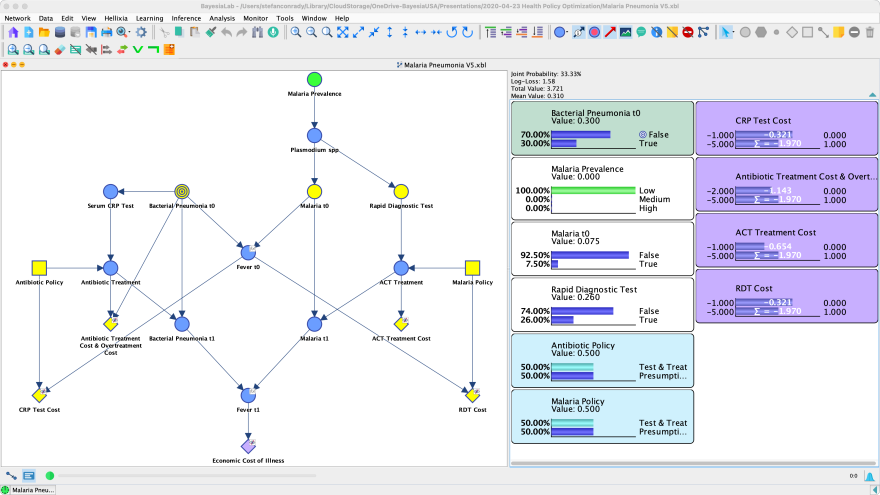
From Expert Reasoning to Network Structure
Subject-matter experts often describe domains as networks of causes, consequences, conditions, symptoms, risks, controls, and decisions. BayesiaLab provides a direct graphical representation for this reasoning.
- Nodes represent variables, concepts, observations, events, or decisions.
- Arcs represent relationships between variables.
- Arc orientation can encode assumed causal direction when the model is intended to be causal.
- Nodes can be added and arranged in the Graph Panel.
- Probabilistic relationships and node properties are managed in the Node Editor.
- BayesiaLab helps maintain a consistent graphical and probabilistic representation as the model evolves.
The resulting network is more than a diagram. It is a quantitative model that can be used for inference, simulation, diagnosis, prediction, sensitivity analysis, and optimization.
Knowledge Elicitation with BEKEE
Beyond direct manual modeling, BayesiaLab supports structured expert elicitation through the Bayesia Expert Knowledge Elicitation Environment (BEKEE).
BEKEE is a web service for systematically acquiring explicit and tacit knowledge from multiple experts. It extends individual expert modeling into a structured workflow for collecting, comparing, and synthesizing expert views before they are compiled into a Bayesian network.
This is particularly useful when the model depends on distributed expertise, when stakeholder perspectives differ, or when a transparent elicitation process is required.
Discrete, Nonlinear, and Nonparametric Representation
BayesiaLab represents probabilistic relationships through Conditional Probability Tables (CPT), without requiring a fixed functional form.
This discrete, nonparametric representation naturally supports nonlinear effects, interactions, and context-dependent relationships. Instead of assuming that a relationship must be linear, additive, or monotonic, the model can represent the relationship state by state.
Continuous variables can be discretized manually or automatically via tools in the Data Import Wizard, Node Editor, and standalone discretization workflows.
How Knowledge Models Become Analytical Models
A knowledge model can serve as the starting point for a broader BayesiaLab workflow:
- Experts define the initial structure and assumptions.
- Analysts refine the model through probability elicitation, simulation, and review.
- Data can be introduced later to estimate, validate, or revise parts of the model.
- The resulting Bayesian network can be used for inference, causal analysis, and decision support.
This makes knowledge modeling complementary to machine learning. Expert knowledge can define a structure where data is weak, while empirical data can refine parameters or reveal additional dependencies.